Exploring Metroidvania: The History Of A Word
“Metroidvania” is a portmanteau of Nintendo’s Metroid and Konami’s Castlevania. But how has its meaning changed over time?
What got its Wikipedia page deleted for almost a decade?
And why do some people still insist that Metroid is not a Metroidvania?
Critical Kate Is On The Case
This is a transcript of the video embedded above, which is very audio/visual heavy. I recommend watching the video for the full experience.
“Bucket list.” We all know what the term means, but can you recall where you first heard it? Most of us can’t. And why would we? It’s simply one of those timeless, age-old American idioms that’s been passed down from generation to generation for longer than we can possibly know.
Except, it’s not.
It was actually created for the 2007 buddy comedy The Bucket List, starring Jack Nicholson and Morgan Freeman, a film that — to be completely honest with you — I still haven’t seen. And yet, I still managed to pick up on the lingo, thanks to the inescapable barrage of movie trailers and TV spots that went out of their way to define it:
The reason we all feel like we’ve always known it is due to the way our brain prioritizes memories. We continue to pick up new bits of language here and there through osmosis, but what we don’t remember is when and where we were when we learned each new word.
Which is why, even though I am completely obsessed with the subgenre commonly known as Metroidvania, I absolutely could not tell you where I first heard it. On an intellectual level, I know it couldn’t have been before 2009 — based on what I’ve learned while making this video. And yet, on some deep level, I feel like I’ve known it my whole life. I can’t remember what it felt like to not know it.
Which got me wondering about a much broader question: How did the game industry at large come to know of the word “Metroidvania”? What follows are the results of my investigation.
Exploring Metroidvania
June 11th, 2001. Castlevania: Circle Of The Moon is released in America for the Game Boy Advance. It’s the 13th game to use the “Castlevania” name, but only the second of these to include elements reminiscent of Super Metroid — the first being 1997’s Symphony Of The Night for the Sony PlayStation.
June 14th, 2001. Usenet poster Richard Hutnik reviews Circle Of The Moon on the forum “rec.games.video.nintendo,” jokingly nicknaming the game “Metroidvania.”
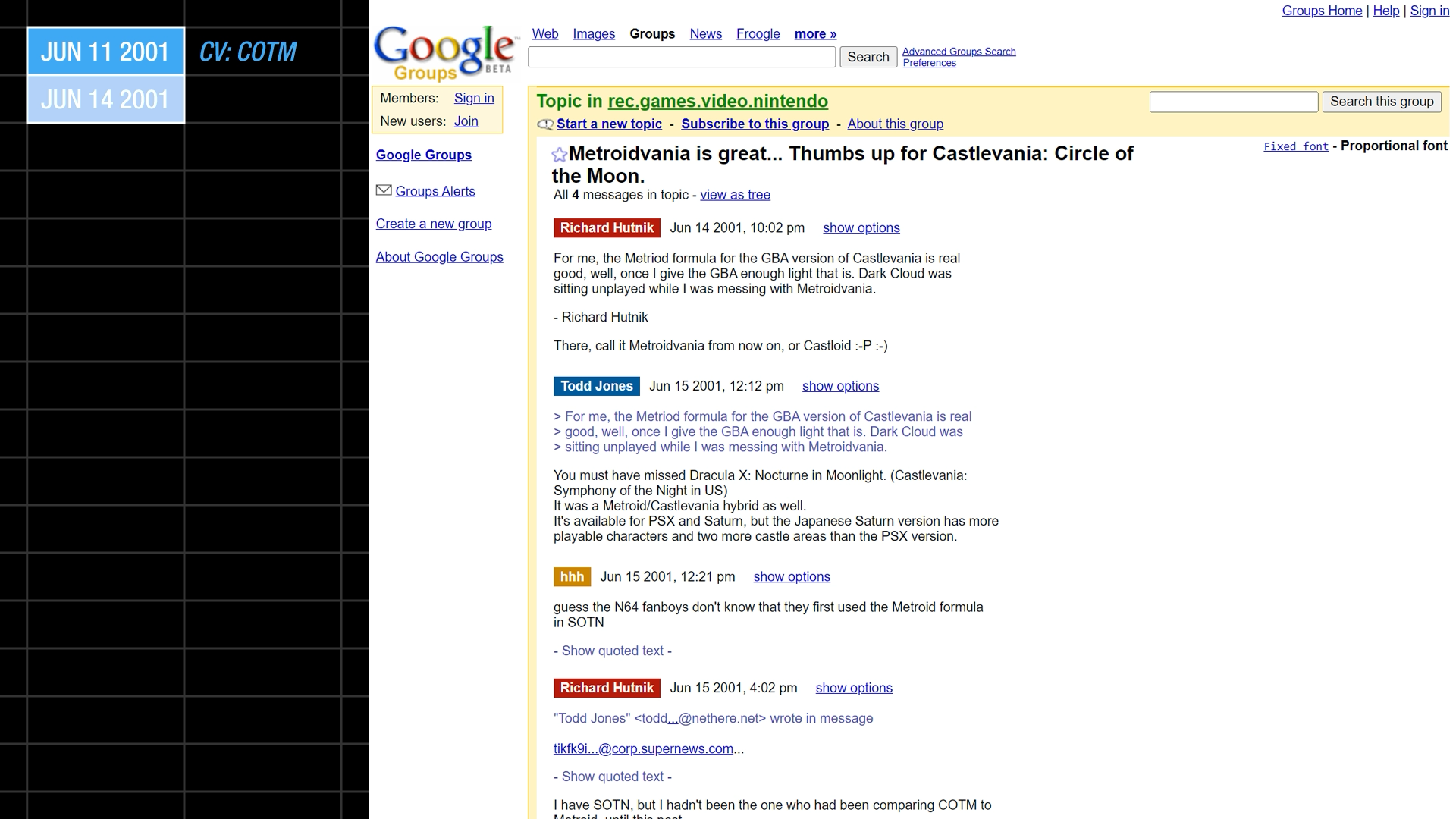
“Or Castloid,” he adds. But neither name catches on with Usenet. When asked about it years later, Hutnik expresses surprise that he might’ve been the first person to use the term but then, do you remember every throwaway joke you’ve ever made on the internet?
January 24, 2003. After the release of a second GBA installment — and the announcement of a third — forum poster “Rade” tells the Castlevania Dungeon Mailbag that he was initially disappointed when he heard they were getting “yet another Metroid-Vania style game.”
The use of a hyphen suggests to me the possibility that he might’ve coined it independently of Hutnik, but when I reach out, Rade isn’t so sure, speculating that it may have already been in common usage on the forum. I attempt to search the forum, but unfortunately it moved hosts multiple times, and its earliest incarnations — like most forums from the early-2000s — have since been lost to time.
However, I notice that 11 months before Rade’s letter, the mailbag hosted a discussion pitting Metroid against what it called as “the exploratory Castlevania games.” The term “Metroidvania” never comes up once, confirming that it was not yet in common usage.
But I’m still not satisfied. I decide to comb through the handful of early gaming forums that haven’t yet been wiped out, and while I don’t find anything that predates Rade’s message, what I do find is that “Metroidvania” was slowly beginning to spread. Only, it had a slightly different meaning. Not “Metroid-style games,” but more specifically “Metroid-style Castlevania games.”
February 25th. A Digital Press user says he loves “the Metroidvania games.”
March 21st. A Next Level user says a screenshot for Shantae Advance looks like “a MetroidVania.”
August 13th. An IGN user joking refers to Symphony Of The Night as “Metroidvania,” but a few posts later uses the word to describe the entire category of Castelvania games. However, as the series approaches its fourth entry in as many years some people are beginning to tire of the Metroidvanias.
January 28th, 2005. Gaming Age Forum user Duckroll coins the term “Igavania,” a reference to Castlevania producer Koji Igarashi. Incidentally, Duckroll will later become the accidental inspiration for the term “rickroll.” Get this:
So on April 1st, 2005, a thread about a Duck Hunt April Fools gag gets sidetracked by a discussion of the intent behind Duckroll’s unique screen name. In response, a GAFer named “Ferricide” is inspired to create a photomanip of a duck on wheels.

A year and a half later, anonymous imageboard 4chan discovers the graphic, and becomes absolutely obsessed. Suddenly the image is being used as the punchline to “bait-and-switch” pranks, in which a user sees a link claiming to be something exciting, only to click on it and realize they’ve been… Duckrolled!
When one prankster starts substituting the duck for a video of Rick Astley, this new variation is dubbed a “Rickroll.” But as of this writing, neither Wikipedia nor KnowYourMeme mention that the Duckroll image originated on GAF, so you heard it here first.
But to bring things full circle, it turns out that “Ferricide” — the creator of the Duckroll image — is the screenname of game journalist Christian Nutt, whose preview of “Castlevania DS” coincidentally goes live the day after Duckroll coins “Igavania.” Under “Cons,” he notes:
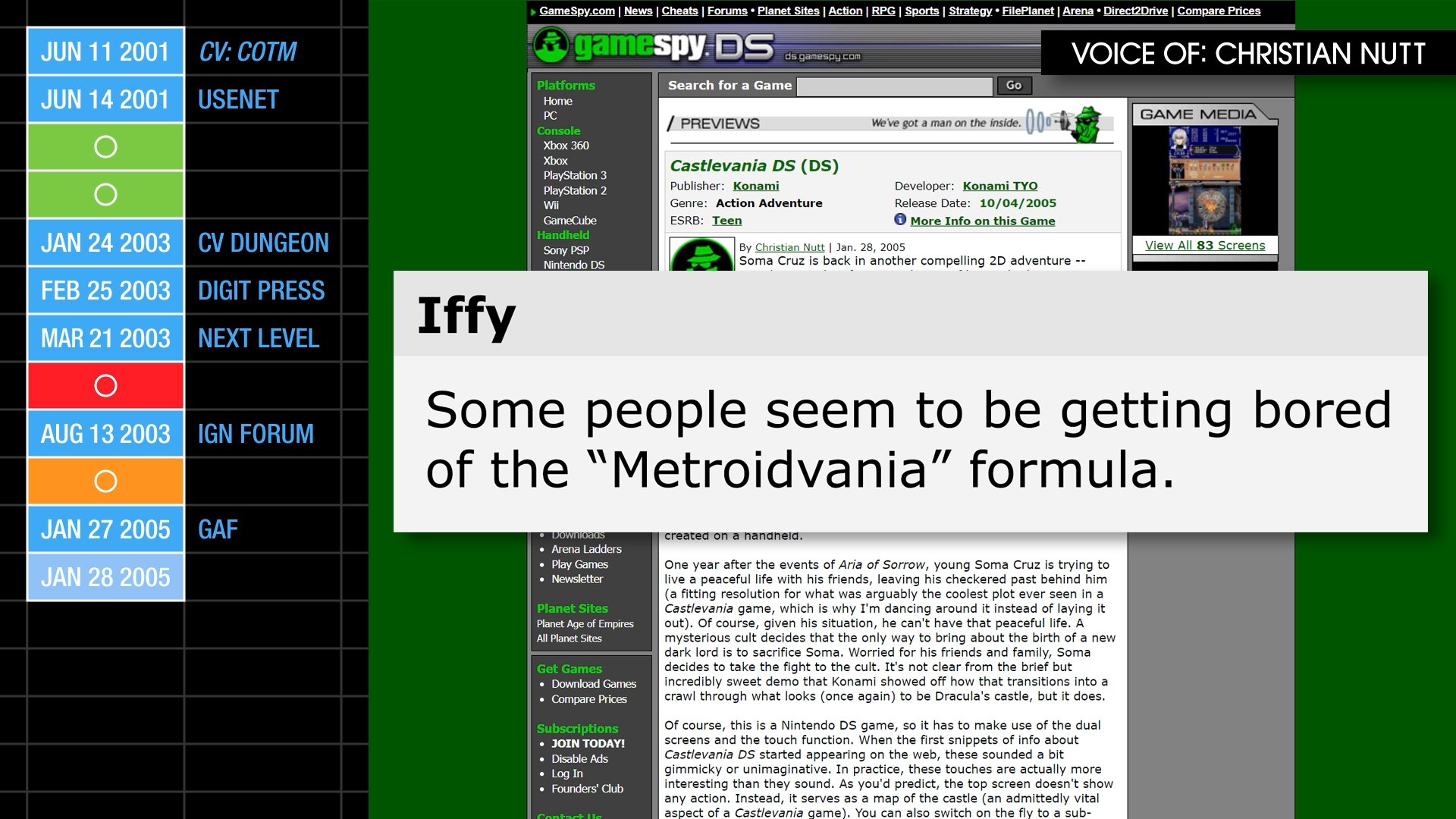
This makes him the very first game journalist to use the word “Metroidvania” in an article about Castlevania, and he won’t be the last.
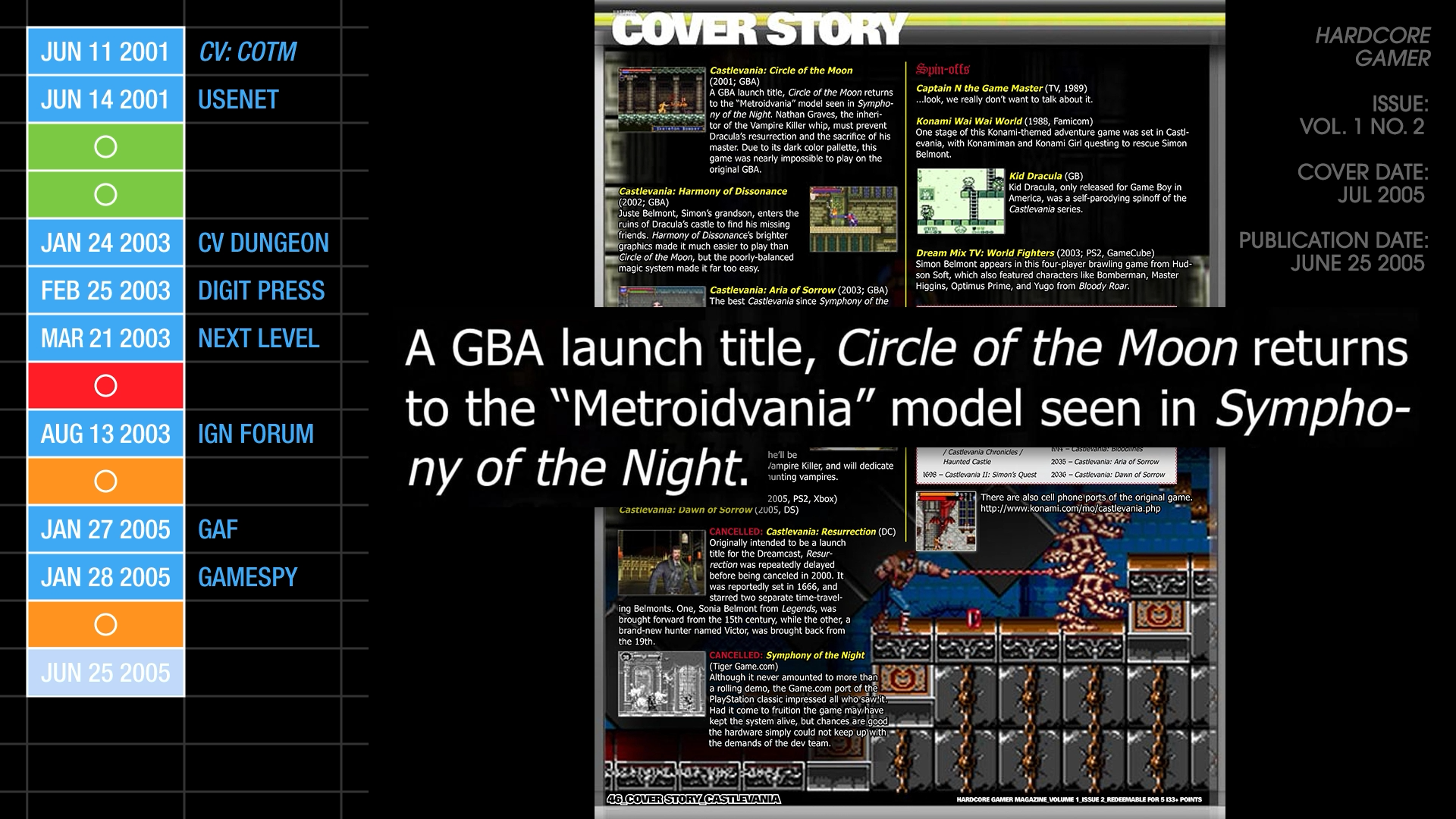
June 25th. Adam Pavlacka uses the word in Hardcore Gamer magazine, the first time the word appears in print.
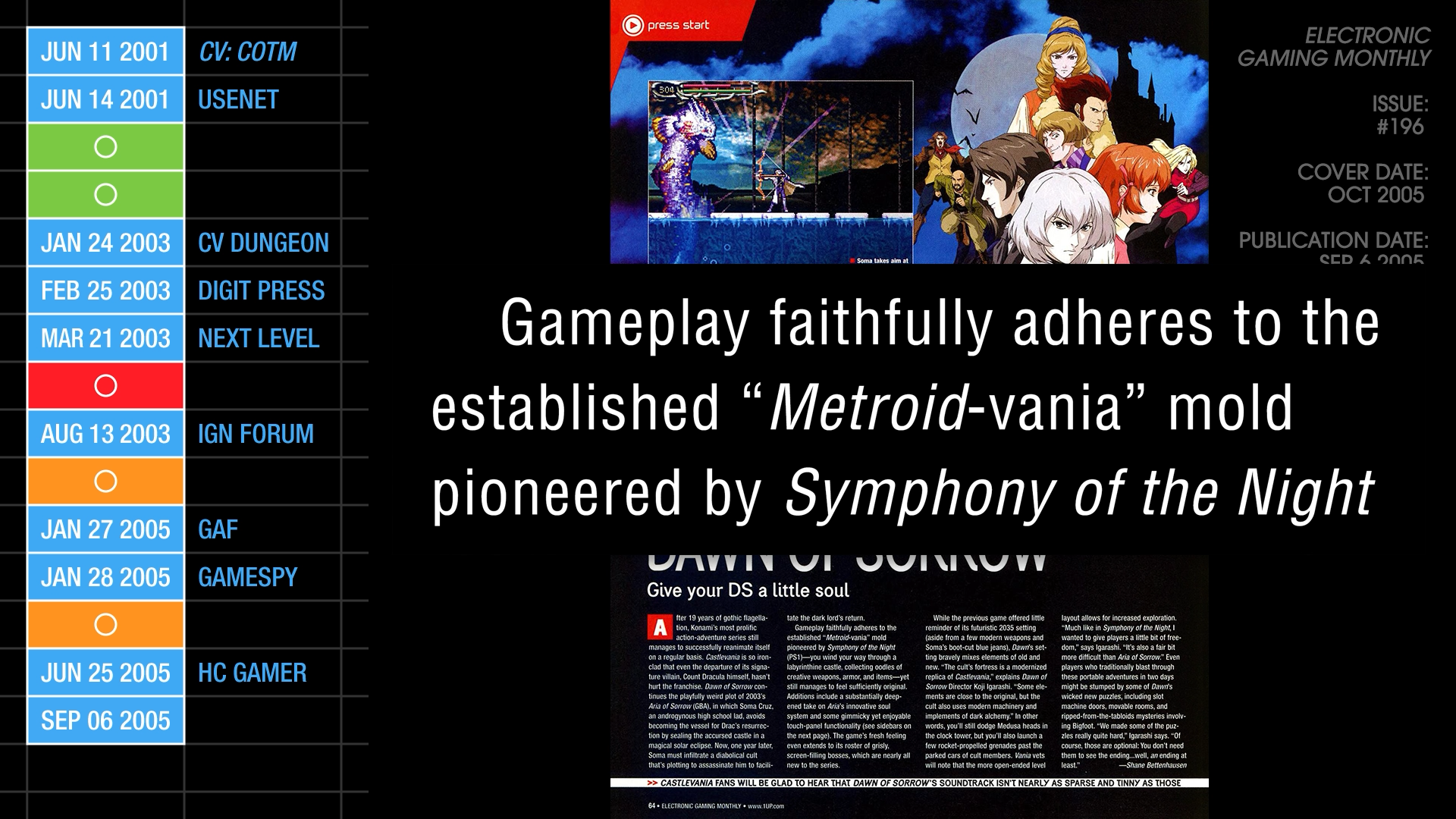
September 6th. Shane Bettenhausen uses the word in Electronic Gaming Monthly. He tells me a copy editor insisted on including the hyphen.
October 3rd. 1UP’s Jeremy Parish comes to the surprising conclusion that “the ‘Metroidvania’ format is pretty well mined,” though he finds it hard to complain when the game is this good.
Eventually Parish’s name will become so closely associated with “Metroidvania” that, to this day, he’s still mistaken as the creator of the word. When I ask him about it, he says he first recalls seeing it years earlier on the forum of Scott Sharkey, who would soon become a 1UP contributor himself. Unfortunately, being a forum from the early-2000’s, it too has been lost to time.
However, within the snapshots of the 1UP website, I discover something surprising. It turns out that not only was Sharkey the first person to use the word “Metroidvania” on 1UP — even before Jeremy Parish — he also used it before Christian Nutt. Because while Nutt may’ve been the first journalist to use the word while talking about Castlevania, Sharkey was covering the games no one else was talking about.
Expanding Metroidvania
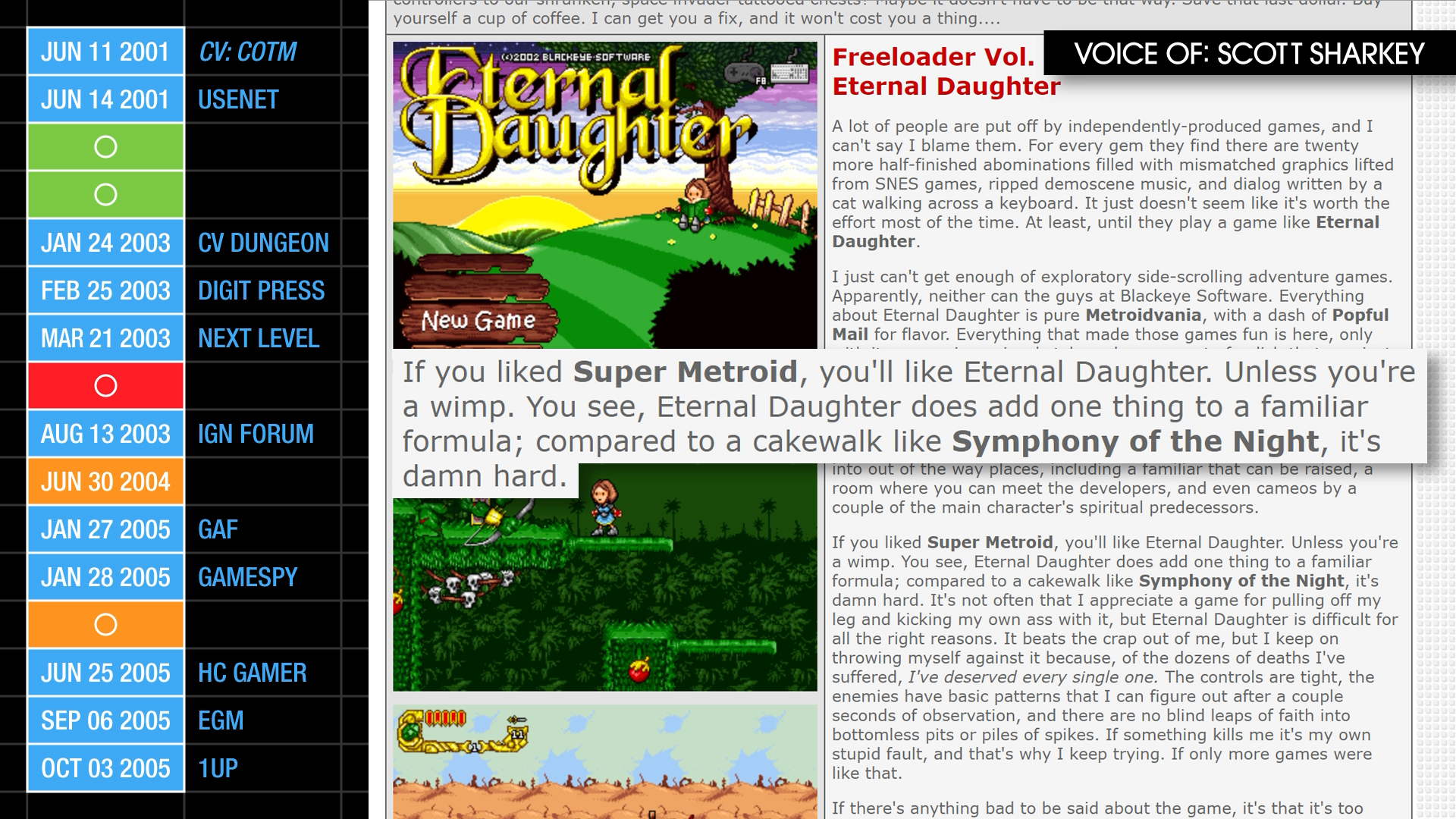
June 30th, 2004. Sharkey reviews Eternal Daughter, a freeware game co-created by future Spelunky and UFO-50 developer Derek Yu. Sharkey describes the game as “pure Metroidvania, with a dash of Popful Mail for flavor.” In the next paragraph, he elaborates:
February 2nd, 2005. Sharkey becomes the first journalist to write about Cave Story, only months after the creation of an English fan translation. Perhaps controversially, he groups it in with “Metroidvania-style adventure games.”
April 21st, 2006. Parish blogs about his plan to design a video game with a “Metroid/Castlevania structure,” which sadly never makes it beyond the sketchbook stage. Although he seems reluctant to use the word “Metroidvania,” that will all change within a week.
April 26th. Parish posts a list of platform adventures to his homepage Toastyfrog in a subsection entitled “Metroidvania,” which he describes as “a stupid word for a wonderful thing.”
April 28th. Parish’s list is discussed on The Gamer’s Quarter forum. While two of the earliest responses argue that Metroidvanias are actually Metroid-style Castlevania games, others are more than happy to run with it, brainstorming additional platform adventures to add to the list.
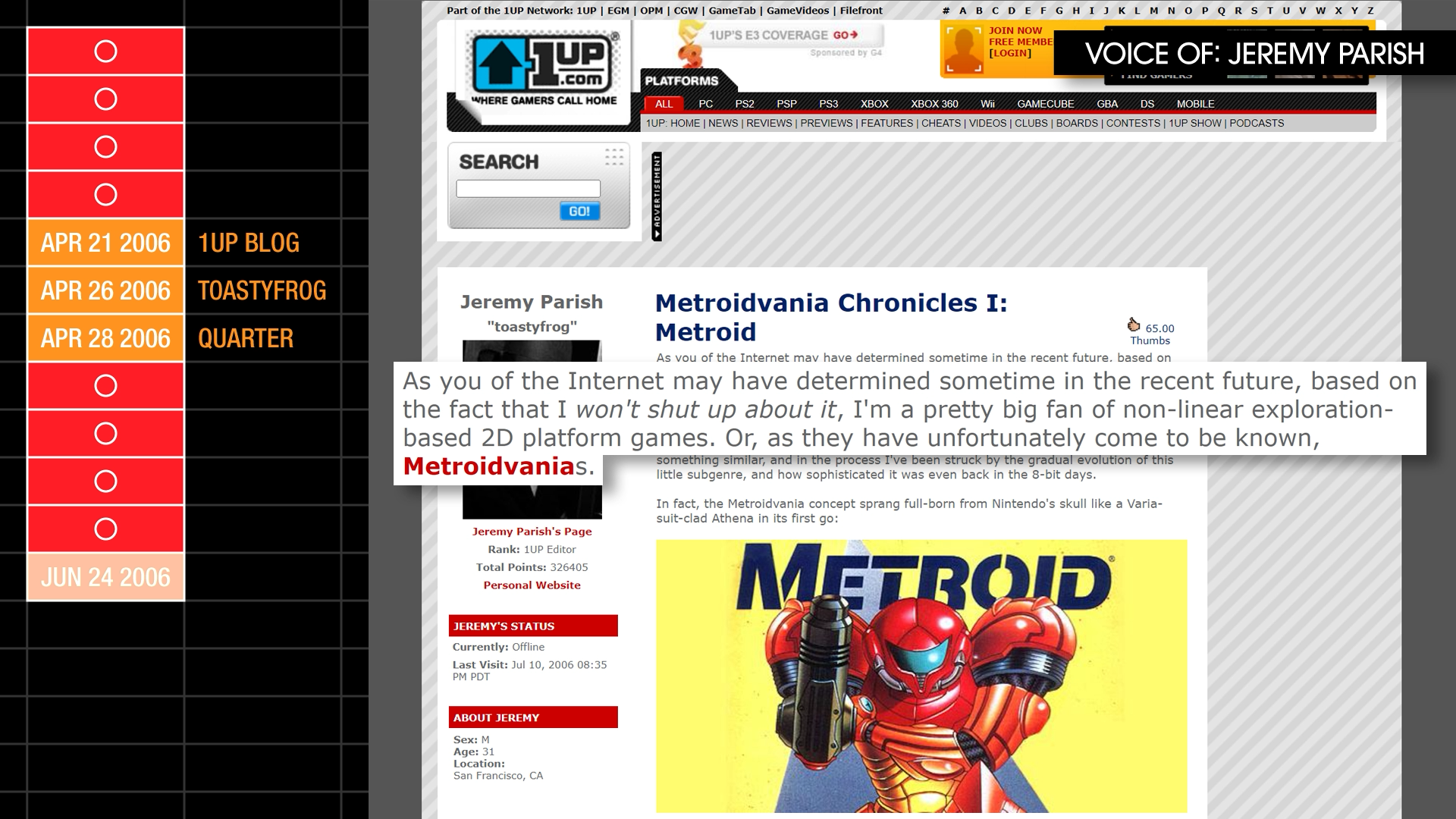
June 24th. Parish begins the Metroidvania Chronicles, a precursor to his eventual Youtube series Metroidvania Works. In his introductory post, he becomes the first person to really make an attempt at trying to define the word:
A week later, Parish registers the domain name Metroidvania.com.
August 22nd. Parish’s Retronauts column transforms into a full-blown podcast, beginning with a Metroid-themed pilot episode.
March 26th, 2007. In a strange and chaotic Retronauts supplement entitled “Debunking Metroidvania,” Parish attempts to defend his broad use of the term to Scott Sharkey — who posits that it’s a “dead genre” — as well as to Chris Kohler, who questions its very existence. If this unusual turn of events feels almost like a genre being laid to rest, an epilogue makes it perfectly clear: “Today, even Wikipedia disavows the word ‘Metroidvania.’”
But why would Wikipedia disavow the word? Whether the Retronauts crew knew it or not, a major cause of the Wikipedia drama was a forbidden word, which you can hear uttered during an earlier exchange in the podcast:
Parish: “I dunno, I blame you for the whole Metroidvania term, anyway. The first time I ever heard the word is when you were using it.”
Sharkey: “So it’s my fault. Would you rather it was Castleroid?”
Castleroid
May 10th, 2003. One week after the release of the third GBA installment, an Amazon review describes the gameplay as “Castleroid (or Metroidvania)” in style. Not to be confused with “Castloid,” which was previously coined by Richard Hutnik.
The review’s author, Ed Oscuro, was not only a regular on the Digital Press forum, but also happened to be one of the Castlevania Dungeon’s moderators. When I reach out, he’s unsure how long either word had been in use for, but admits that he loves a good “spoonerism” — a form of wordplay in which the expected order is reversed for comedic effect — and so, “Castleroid” may very well have been his fault.
On the Dungeon forum, the word is enthusiastically embraced by a small but passionate group of fans who prefer how “Castleroid” places Castlevania first.
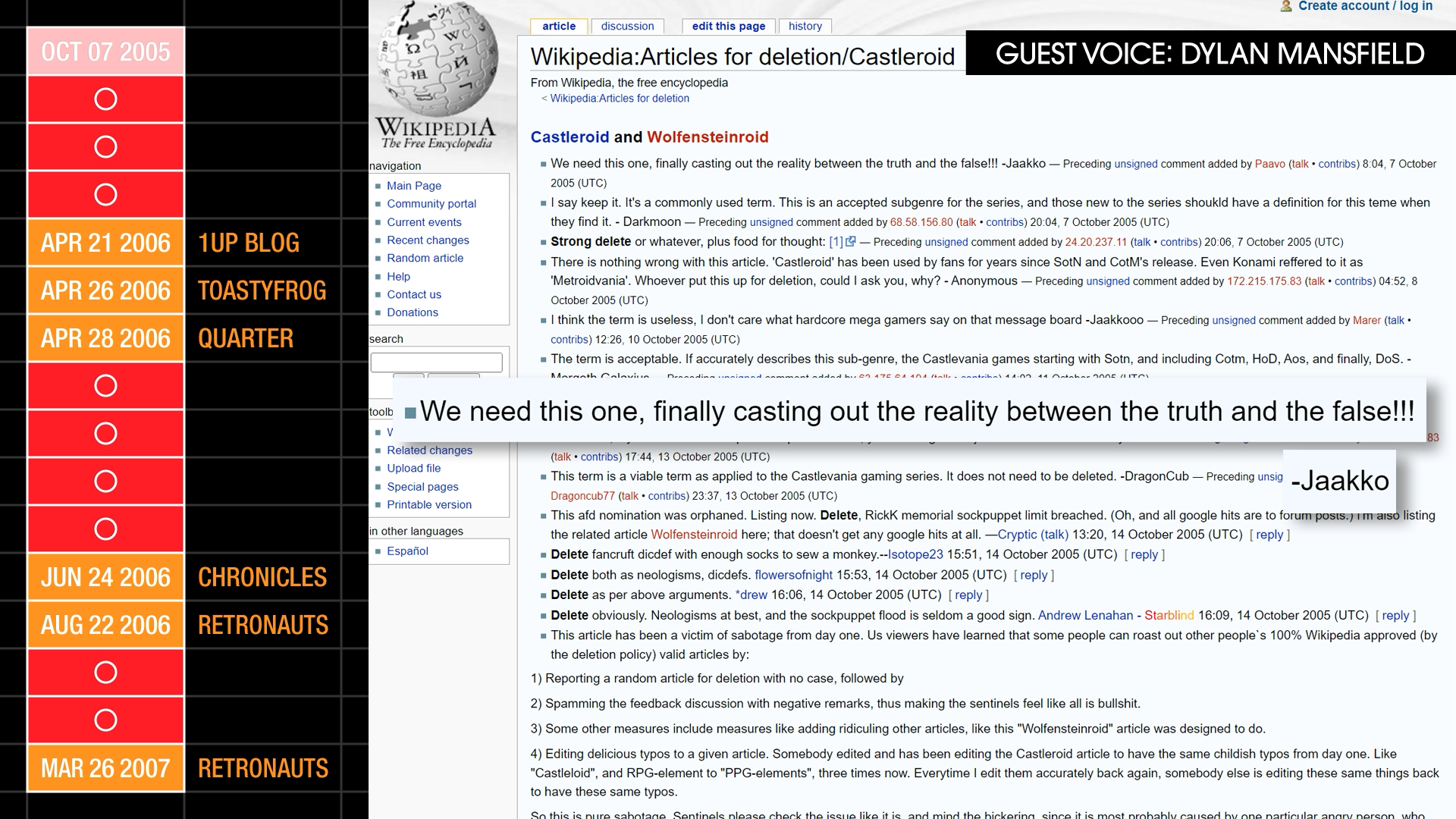
October 7th, 2005. A Dungeon regular creates a Wikipedia entry for “Castleroid.” It’s filled with numerous unsourced claims, such as that the word “Metroidvania” first appeared in the late ‘90s, and that “Castleroid” quickly eclipsed it. The entry is immediately nominated for deletion.
Unsurprisingly, the entry’s creator – objects:
But others disagree. A Man In Black argues, “Delete little-used neologisms. Metroidvania is more commonly used, in my experience, than Castleroid, but I’d vote delete on articles about either.”
The result is “Delete.”
December 12th. A Wikipedia user creates an entry for “Non-linear exploration.” Among its list of alternate names for the genre, the most common term — “Metroidvania” — is conspicuously absent.
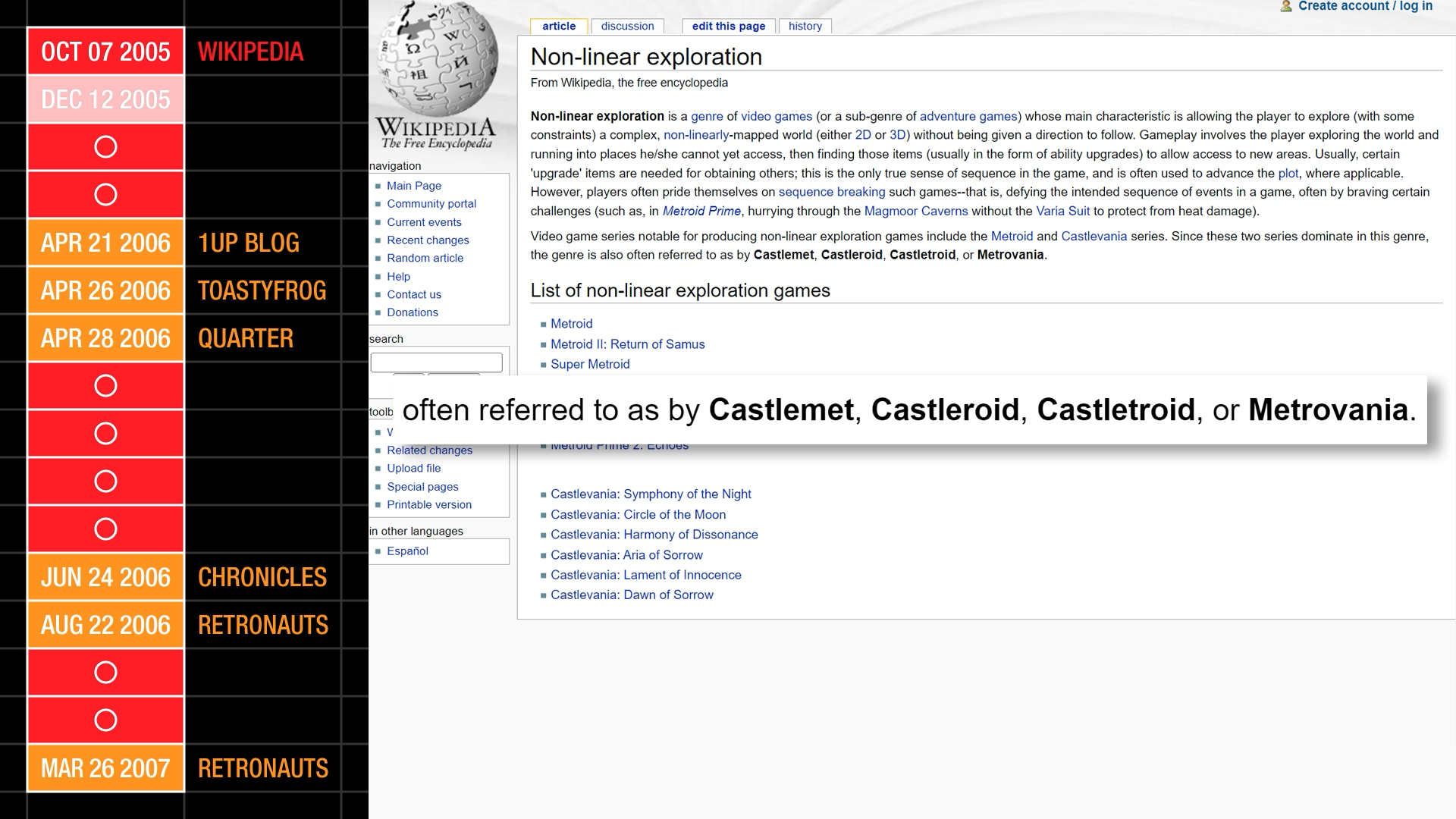
February 1st, 2006. “Non-linear exploration” gets nominated for deletion, but there is no clear consensus. Instead, someone takes it upon themselves to change the entry’s name to…“Castleroid.”
February 27th. Wikipedia user Guermantes removes all the games from Castleroid’s page that aren’t Castlevania games, and then creates a separate page for “Metroidvania,” so that it can function as a redirect to “Castleroid.”
May 4th. Wikipedia user Luvcraft creates an entry for “Metroid-style game.” He attempts to redirect “Metroidvania” to this page, but Guermantes immediately reverts it, noting that “Metroidvania” is a synonym for “Castleroid,” and as such, does not include Metroid-style games.
Luvcraft attempts to compromise by turning “Metroidvania” into a disambiguation page that links to both entries, pointing out that the word does not yet have a “concrete definition.” But Guermantes, once again, reverts it.
Luvcraft re-reverts it, and includes a link to a game review that uses the term, and that seems to do the trick. For now.
May 16th. A Wikipedia user wants to revert the page back to a redirect, but their suggestion is summarily ignored.
June 2nd. An anonymous Wikipedia user edits “Castleroid” to insert the following statistic:
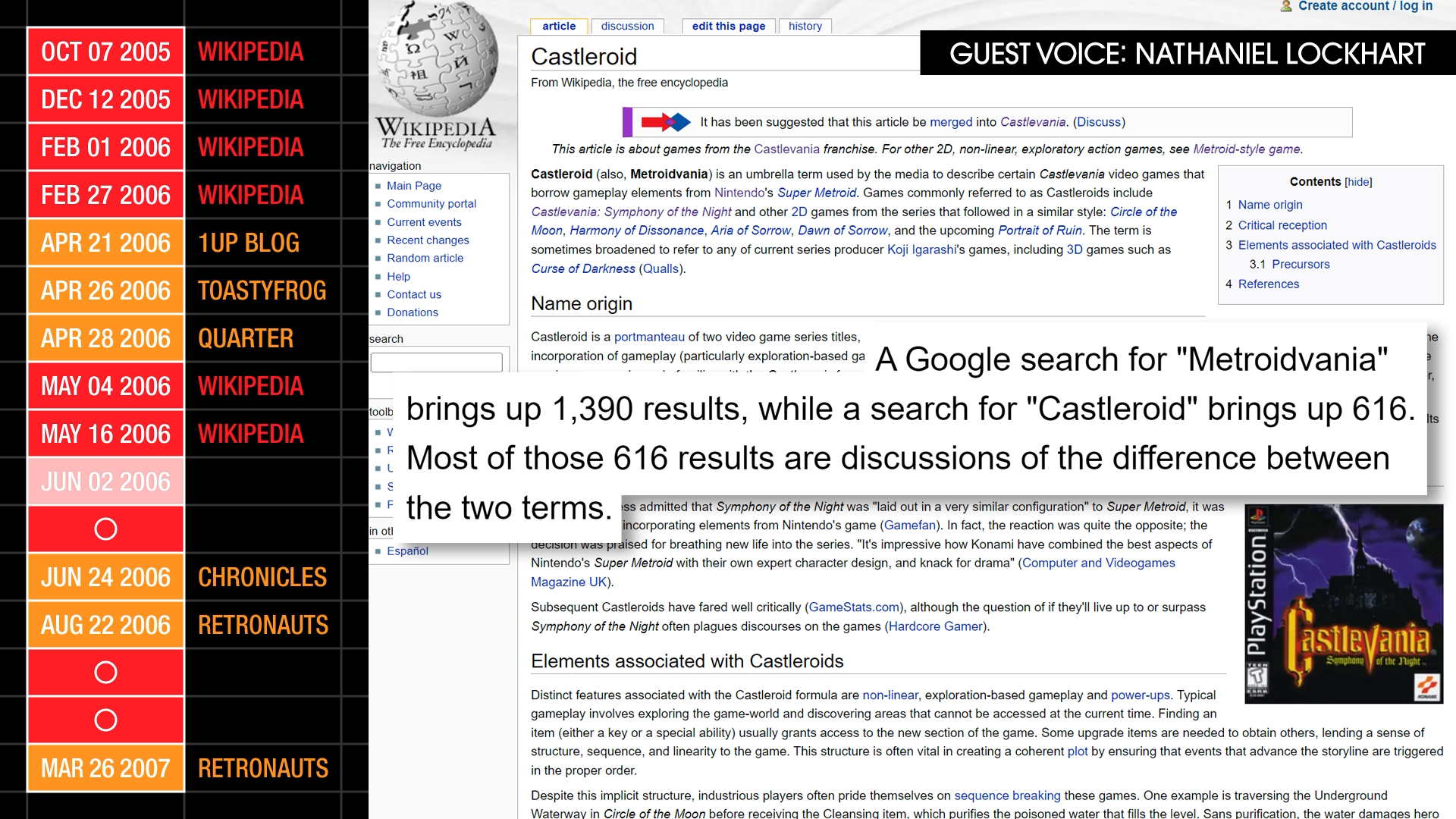
Because this is considered “original research,” the line is quickly deleted.
June 7th. Luvcraft’s Metroid-style list excludes 3D games such as Metroid Prime, leading user Lankybugger to wonder whether the page should be renamed “2D Metroid-style game.”
Luvcraft responds, “Too awkward. ‘Metroidvania’ is the term most often used for this genre, but the creators of the Castleroid article throw a hissy fit if someone tries to modify the Metroidvania article.”
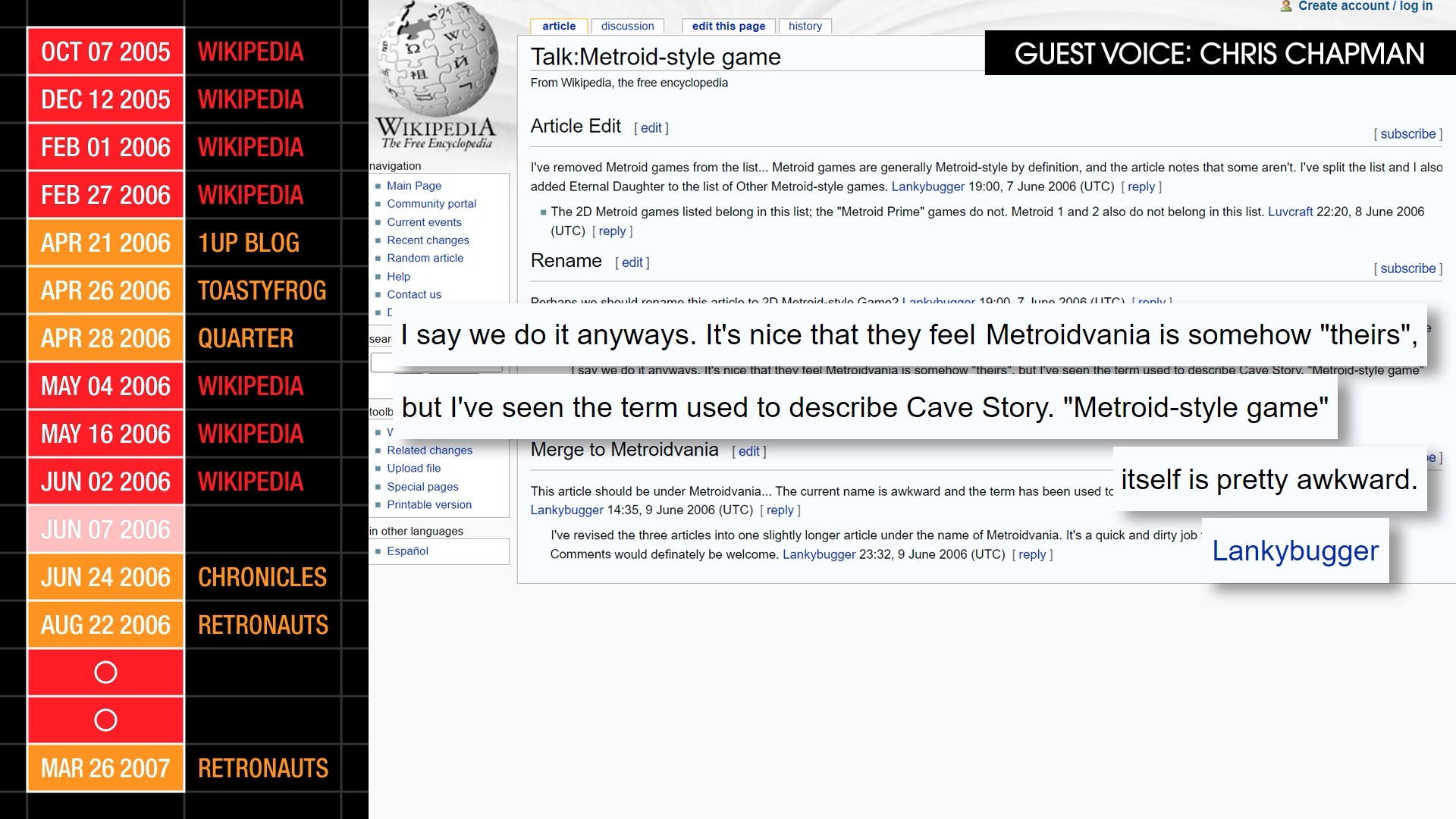
However, in the middle of this discussion, someone finally notices that “Castleroid” hijacked another page after previously being deleted, and so nominates the current page for speedy deletion. But instead of a normal speedy deletion, a decision is made to merge “Castleroid” — as well as “Metroid-style game” — into “Metroidvania.”
And that is how “Metroidvania” won the Great Castleroid War of 2006.
December 5th. A Man In Black inserts an “original research” warning. Over the next week, Lanky re-works the article to add more sources, and removes the warning.
December 13th. A Man In Black re-inserts the “original research” warning, asserting that there are “Still no references that support the claims made here.” The warning is removed by Luvcraft, but the next day A Man In Black puts it back, along with a “weasel words” warning and “citation needed” flags after every statement that isn’t backed up. Luvcraft gets to work adding sources wherever possible, and deleting any statements that can’t be sourced, which — to be clear — is most of them.
Afterwards, Luvcraft writes the following heartfelt plea:
“Although I’ve put a lot of work into this article, I’ve recently realized it does not pass WP:NEO, because there has never been a definitive work on the subject (the toastyfrog article does not count). When I first joined Wikipedia, it welcomed neologisms, quirky articles, and even original research with the expectation that such seeds would sprout into full, referenced articles. The current Wikipedia is a very different beast, or maybe I was just deluding myself.
This article does not belong in the current Wikipedia.”
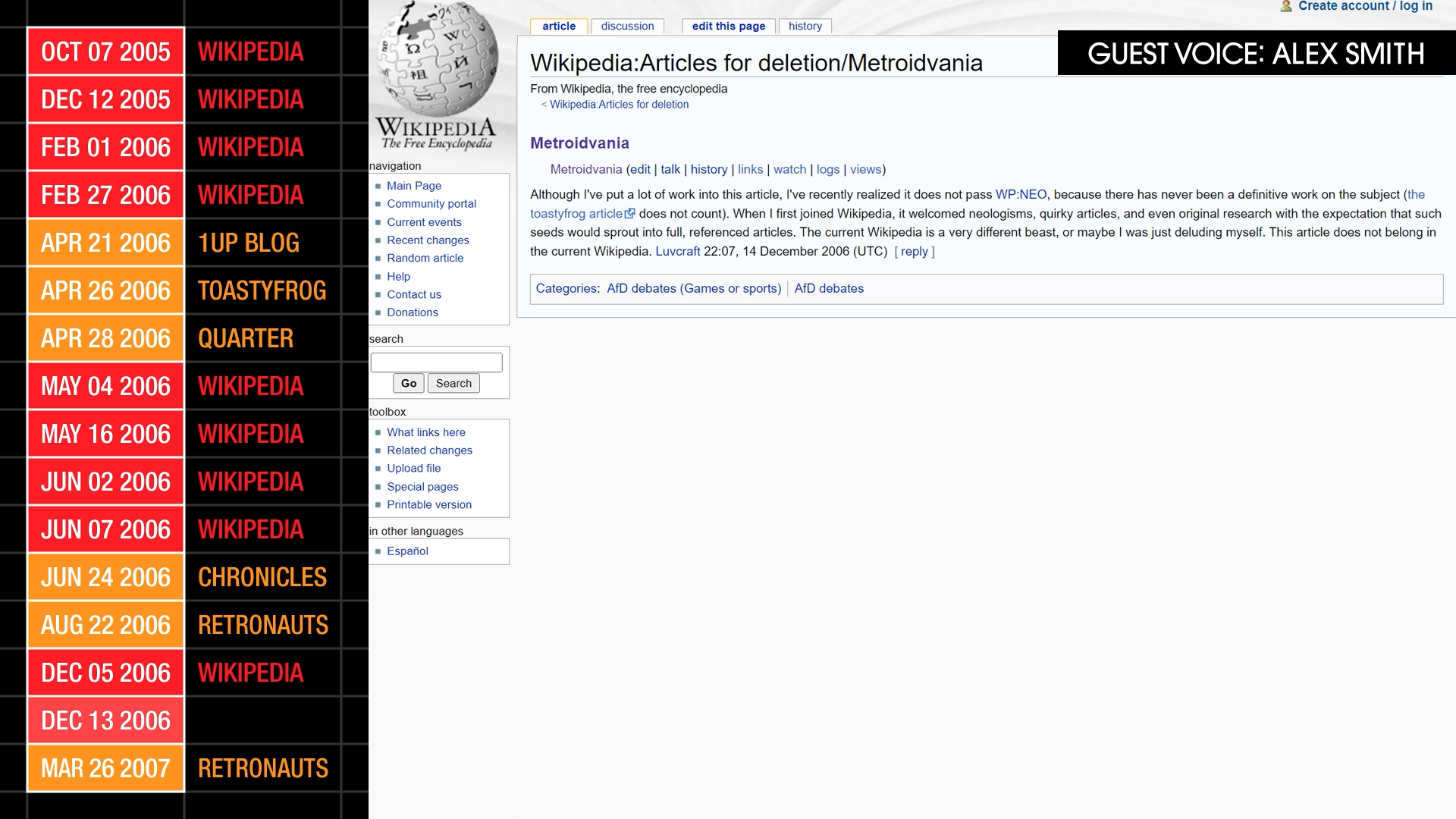
The result was “Delete.”
Reviving Metroidvania
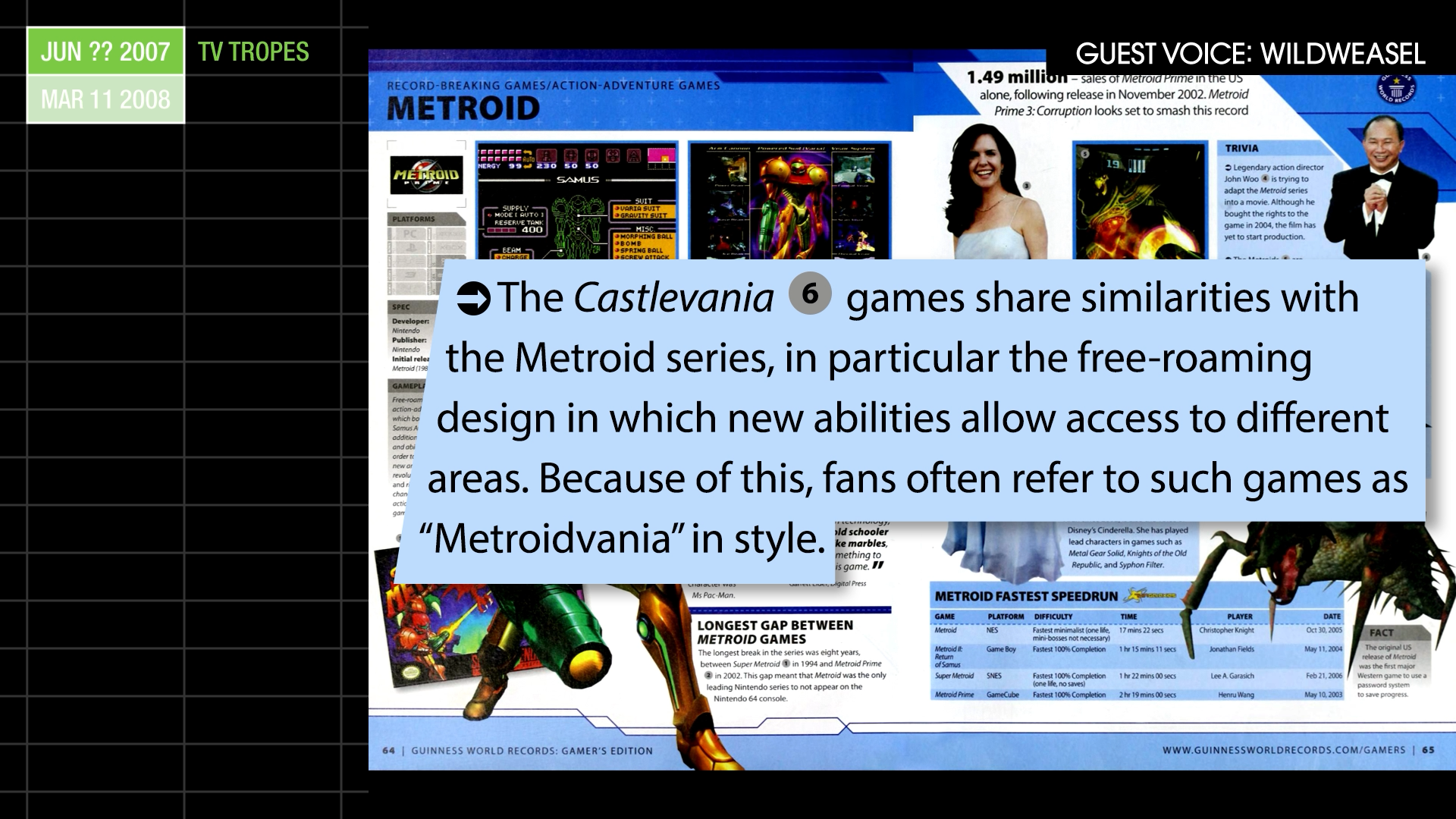
June 2007. TV Tropes starts a “Metroidvania” page. However, they erroneously attribute the word to Jeremy Parish. So I guess blame TV Tropes for that one.
March 11th, 2008. Guinness World Records publishes its first Gamer’s Edition. The Metroid spread includes the following bit of trivia:
June 4th, 2009. At an E3 demonstration of Shadow Complex — the first console-based Metroidvania in over a decade — Chair Entertainment’s Donald Mustard becomes quite possibly the first game developer to describe his own game as a Metroidvania:
“Growing up, one of my favorite games ever, that’s ever been made, and is still one of my favorite games is Super Metroid. I loved the non-linear kind of open world design of kind of the Metroidvania games … So our goal with Shadow Complex was to take the best of those games, of the Metroidvanias, and kind of bring them into the next generation”
When the review embargo ends, almost every critic describes the game as a “Metroidvania.” X-Play’s Morgan Webb becomes the first person to say the word on national television.
August 27th. Thanks to all the newfound attention, the Wikipedia page for “Metroidvania” is updated so that it’s no longer a redirect to “Action-adventure game,” but instead a redirect to “Platform game.”
In the meantime, the success of Shadow Complex leads to a small but steady stream of console-based Metroidvania games. Wikipedia won’t recognize the genre as notable, but fans and developers know it…in their hearts.
March 18th, 2014. Former 1UP editor-in-chief Jeremy Parish interviews former Castlevania producer Koji Igarashi, who reveals that Konami has asked him to limit his use of the word “Castlevania,” and for this reason he’s decided to name his GDC talk: “There And Back Again: A Metroidvania Tale.”
But during the talk, he surprises the audience by revealing that the initial inspiration for Symphony Of The Night was actually The Legend Of Zelda. Unfortunately, people erroneously take this to mean that Zelda was its sole inspiration, despite Igarashi previously citing Super Metroid as an influence on multiple occasions.
!["He told use that Super Metroid was a big influence on his design." "[Super Metroid] is a great game that had a lot of direct influence over Symphony." "Since there hadn't been a Metroid for quite some time, we thought,w hy not try to make a better version of Metroid, but in the world of Castlevania?"](https://www.acriticalhit.com/wp-content/uploads/2025/12/2002-05-07-Metroidvania-SOTN-Zelda-Super-Metroid-Igarashi.png)
Regardless, when he launches a Kickstarter campaign the following year, he decides he wants to steer clear of any Nintendo trademarks, and so drops the term “Metroidvania” in favor of “Igavania” — the NeoGAF term whose origins by this point had long since been forgotten.
March 26th. The users of NeoGAF attempt to investigate who coined the phrase “Metroidvania.” They eventually trace it back to Richard Hutnik.
February 12th, 2015. Former GameSpy writer Christian Nutt — the first game journalist to use the word “Metroidvania” in an article about about Castlevania — puts together a feature called “The Undying Allure Of The Metroidvania,” in which he asks Igarashi and other developers what drew them to the genre. As luck would have it, it’s this very article that acts as the catalyst that finally gets “Metroidvania” reinstated on Wikipedia. And the rest…is history.
Or that’s how this chapter was going to end, until a new detail came to light.
Over in my Patreon-only Discord, Karobit mentioned that in the early-2000s, when he used to hang out on IRC — which was sort of like the Discord of its day — that he held on to a number of his old chat logs. Naturally, my first question was whether anyone used the word “Metroidvania.”
And you know what? They did! Not only that, the earliest mention was from January 17th, 2003, which predated the Dungeon Mailbag column by one whole week. But what truly shocked me was who said it:
Duckroll.
[11:28]  <bludstone | work>  another goth-troid
[11:28]  <bludstone | work>  looks fun tho
[11:28]  <duckroll>  yeah
[11:28]  <duckroll>  i call them metroidvanias though
Could it be possible that the same individual coined both ‘vanias? When I ask him about it, he acknowledges that he coined Igavania, but he isn’t so sure about Metroidvania.
Still, it opens up the possibility that my initial theory was incorrect. What if “Metroidvania” wasn’t spread from the Dungeon, but rather was spread from GAF? You see, while GAF’s archive is mostly preserved and searchable, everything before June 2004 is lost to time. And so, unfortunately, there’s simply no way we can ever know for sure. All we can really do is just accept that we’ve done the best we can.
We’ve seen the word Metroidvania go through an astonishing evolution: from describing a single game, to a series of games, to a broad genre of games, and then back down to a very specific subgenre. And yet, one question still remains:
What the fuck is a Metroidvania?
Defining Metroidvania
Back during the Great Castleroid War of 2006, there was one thing that both sides were fully in agreement on: That the original Metroid was not a Metroidvania.
While the Castleroid folks excluded because it wasn’t a Castlevania game, Luvcraft felt it didn’t count because it lacked an auto-map and an in-game story, two features that nobody really considers defining characteristics of the genre today. But then, how does one define a Metroidvania?
Allow me to try. The oldest ancestor of the Metroidvania is a text-based computer game called Adventure. Inspired by the tabletop RPG Dungeons & Dragons, your objective was to explore a large, nonlinear dungeon while the computer acted as your DM.

Which might sound like it too would be classified as an RPG, except for how the game handled progression. In video RPGs, progress involves gaining experience points so that you can level up and fight tougher enemies. But Adventure had no experience points. Instead, progress involved finding keys to unlock doors, or finding key-like items to solve puzzles that blocked your path.
The game was so influential, that — like Metroidvania — it became the namesake for an entire genre, called “Adventure” games.
Subgenres soon followed, like Graphical Adventures and Point-And-Click Adventures. But when Text Adventures were combined with arcade-style action, they became Action-Adventures. And when Action-Adventures were combined with platforming, they became Platform Adventures.
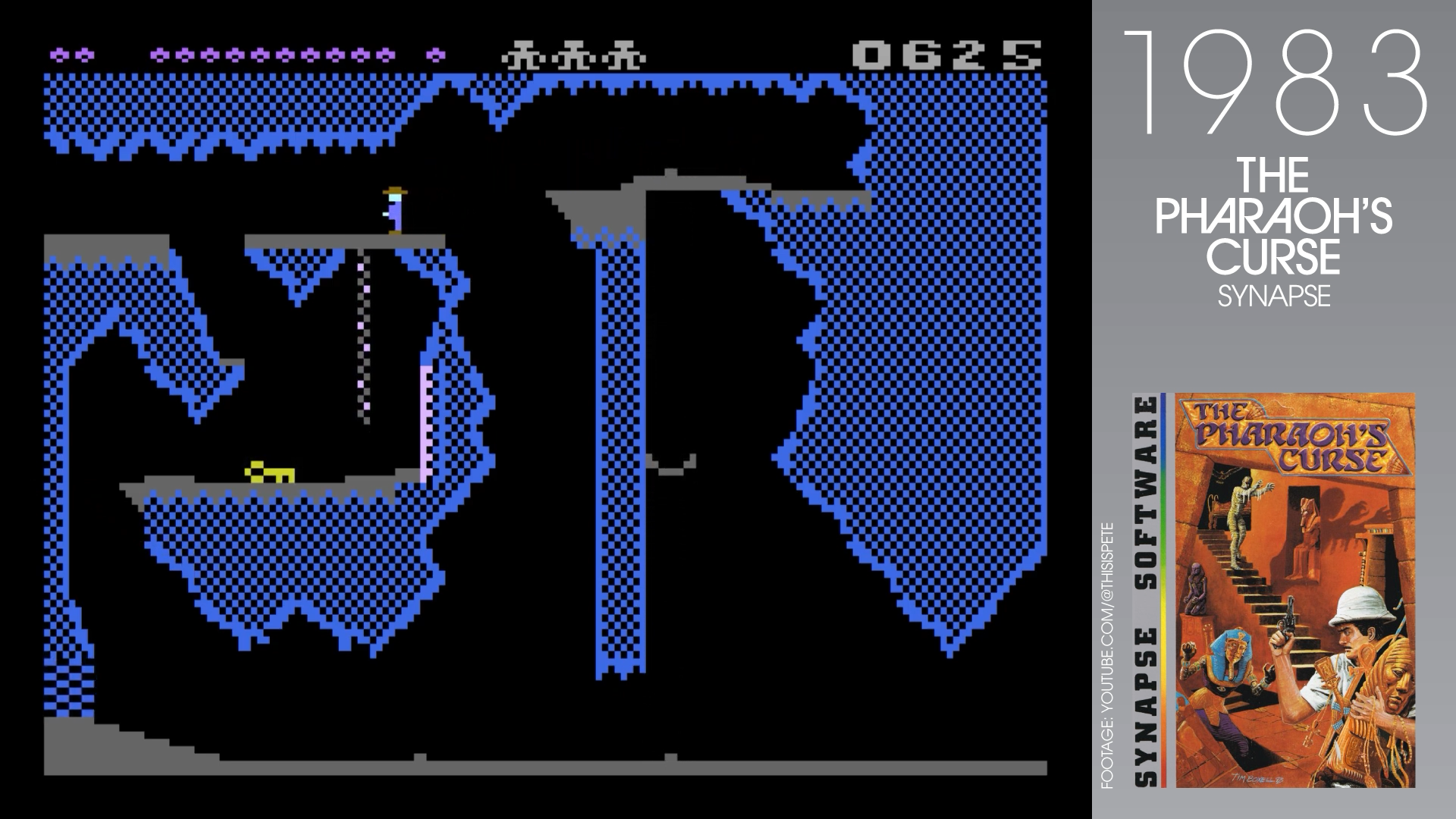
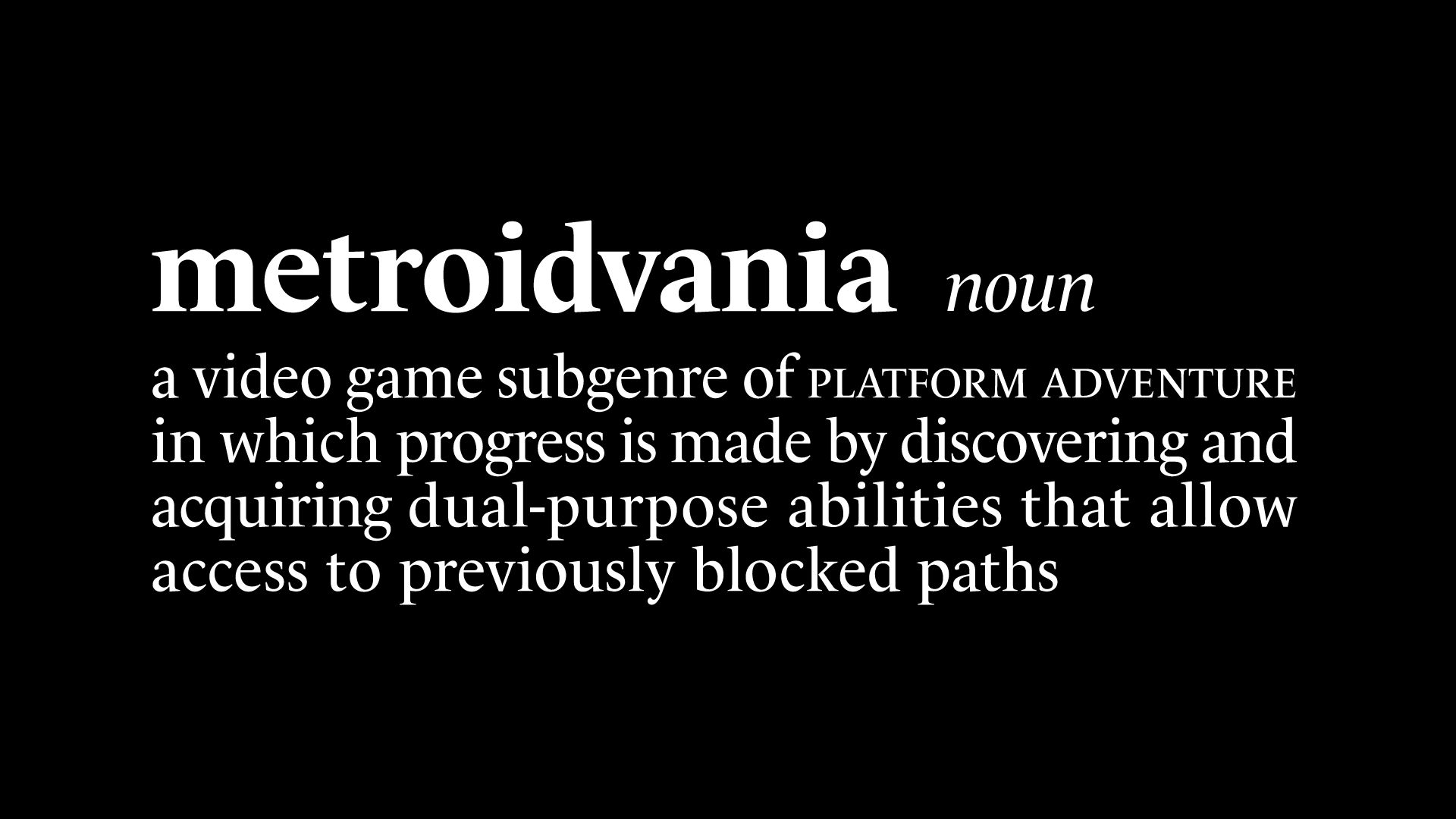
Today, Platform Adventure and Metroidvania are frequently used interchangeably, but I believe Metroidvanias go one level deeper. I propose that the defining characteristic of a Metroidvania is dual-purpose abilities, in which the “keys” you collect double as weapons or mobility upgrades.
Take the original Metroid for example.
Metroid throws you into a large, non-linear dungeon armed with only a short-range arm cannon. Although your shots can be used to both fend off enemies and open doors, in order to complete the game you must also acquire a number of upgrades. These include:
- Missiles, which do greater damage to enemies, but also remove blast shields from doors.
- The morph ball, which gives you the ability to crouch, as well as fit in tiny spaces.
- Jump boots, which allow you to jump higher, and also reach higher places.
- The ice beam allows you to freeze enemies, and the then use them as temporary platforms.
- And bombs serve a triple purpose — they can damage enemies, destroy specific types of blocks, and also let you jump while crouched.
The arm cannon and morph ball are used to reach the bombs and missiles, and the bombs and missiles are used to reach the ice beam and jump boots. Which is essentially the basic gameplay loop of every Metroidvania.
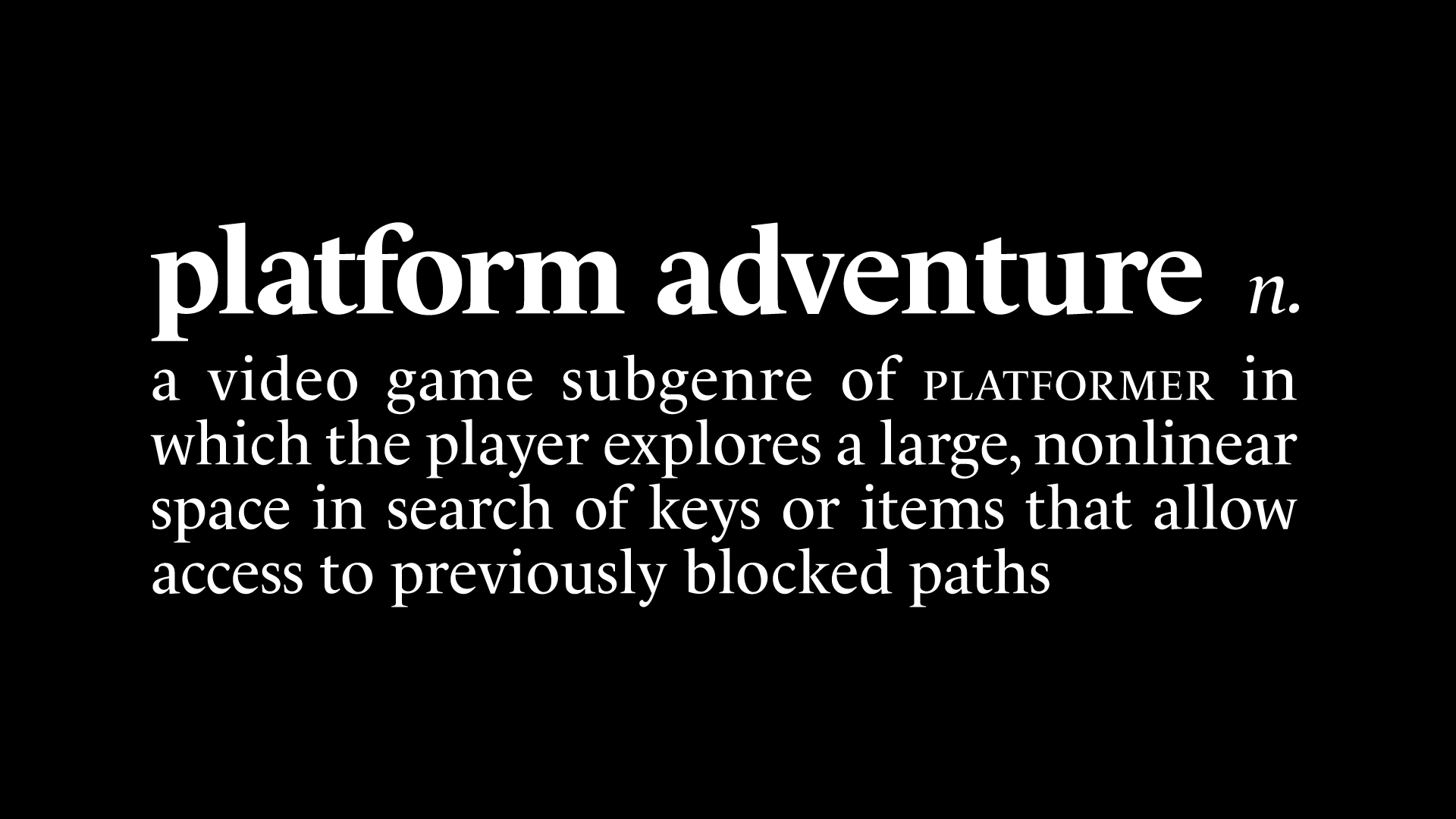
If I were to boil this down into a dictionary-style definition, I first would first define Platform Adventure:
I would then define a Metroidvania as:
From there I might even propose additional subgenres. Symphony Of The Night is a Metroidvania-RPG. Metroid Prime is a Metroidvania-FPS. But it all started…with Metroid.
Or did it? Are we certain there were no Metroidvanias before Metroid?
That’s the central question behind a new series of bite-sized videos I call “MetroidMania,” in which I backtrack through the history of Platform Adventures to see what I can find. If that sounds like fun, please consider supporting my research on Patreon.
SPECIAL THANKS: Shane Bettenhausen, Chris Chapman (Retrohistories), Duckroll, Benj Edwards (Vintage Computing), Ethan Johnson (History Of How We Play), Kurt Kalata (Hardcore Gaming 101), Karobit, The Kinsie, Nathaniel Lockhart (Memory Machine), Shane Luis (Rerez), Dylan Mansfield (Gaming Alexandria), Devin Monnens (Desert Hat), Christian Nutt, Ed Oscuro, Adam Pavlacka, Jeremy Parish (Retronauts), Peaceful Dream, Rade (ESP), Scott Sharkey, Alexander Smith (They Create Worlds), WildWeasel, and The Secret Writers Society.
ADDITIONAL RESOURCES: The Death Generator, Flyercade, Internet Archive, Wikipedia
FOOTAGE: Colossal Cave On ESP32 On ASR33 (RevK), Pedit5 Attempt 2 (TailsFan109), Mystery House (Apple II, 1980) (Electronic Rag), Playing Every Classic Mac Disk E89: Déjà Vu (Macintosh, 1985) (Ryan FB), Pharaoh’s Curse for Atari 8-bit | Atari A to Z (ThisIsPete)
MUSIC:
- “Fast Talking” by Kevin MacLeod
- “Arrival On Crateria” and “Arrival At The Space Colony” arranged by Luminist
- “Sinking Old Sanctuary” arranged by David Westerlund
- “Vampire Killer / Wicked Child” from Perfect Selection: Dracula
- “The Space Pirates Appear” and “Prologue” arranged by Luminist
- “Kraid’s Lair” arranged by Luminist
- “Bloody Tears” arranged by VG Music Revisited
- “Clockwork” arranged by David Westerlund
- “Item Room” arranged by Luminist
- “Tower Of Mist” arranged by David Westerlund
- “Brinstar Overgrown” and “Tension” arranged by Luminist
- “Dance Of Gold” arranged by David Westerlund
- “Item Fanfare” and “Kraid’s Hideout” arranged by Luminist
- “Beginning” arranged by VG Music Revisited
- “Beginning” arranged by David Westerlund
- “Escape” arranged by Luminist
- “Escape” arranged by VG Music Revisited
- “Castlevania III Title Theme” arranged by VG Music Revisited
- “Metroid Title Screen” arranged by VG Music Revisited
- “I Knew A Guy” by Kevin MacLeod
Kevin MacLeod (incompetech.com) tracks licensed under Creative Commons: By Attribution 3.0 (creativecommons.org/licenses/by/3.0/)
Comments
Join the discussion for free on my Patreon page!
You Might Also Like